
What is mmWave 5G Wireless?
The emergence of new 5G New Radio (5G NR or just 5G) standards for mobile cellular networks offer huge increases in capacity and performance. 5G has the potential to deliver a complete transformation of wireless communications. The spectrum for 5G services not only covers bands below 6 GHz, including bands currently used for 4G LTE networks, but also extends into much higher frequency bands not previously considered for mobile communications. It is the use of frequency bands in the 24 GHz to 100 GHz range, known as millimeter wave (mmWave), that provide new challenges and benefits for 5G networks.
The emergence of mmWave wireless is a key part of the 5G revolution, with available spectrum for mmWave, the supported bandwidths, and how antenna technologies work together to deliver multiple Gigabit data rates to end users. Deployment scenarios are considered where 5G mmWave networks will start to make an impact on everyday wireless communications.
The 5G mmWave Spectrum
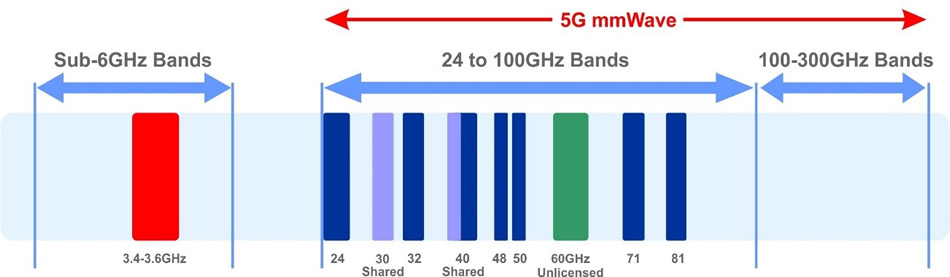
The incredible demand for wireless data bandwidth shows no sign of slowing down now or in the near future. As a result, the mobile data experience for users continues to expand and develop, putting an increasing strain on network use of available wireless spectrum. To meet this projected growth, the cellular industry looked to other frequency bands that could possibly be utilized in the development of new 5G wireless technologies. The high-frequency bands in the spectrum above 24 GHz were considered as having the potential to support large bandwidths and high data rates, ideal for increasing the capacity of wireless networks. These high-frequency bands are often referred to as “mmWave” due to the short wavelengths that can be measured in millimeters. Although the mmWave bands extend all the way up 300 GHz, it is the bands from 24 GHz up to 100 GHz that are expected to be used for 5G. The mmWave bands up to 100 GHz are capable of supporting bandwidths up to 2 GHz, without the need to aggregate bands together for higher data throughput.
The available mmWave bands in the United States provides a good example of the spectrum that can be utilized for 5G networks. The FCC have made more spectrum available for 5G and have signaled that more licensed bands will be opened up for use.
The Challenges of 5G mmWave Deployment
Previously, the use of frequency bands much above 6 GHz was considered unsuitable for mobile communications due to the high propagation losses and the ease with which signals are blocked by not only building materials and foliage, but also by the human body. Although these challenges place limitations on mmWave deployments, new antenna technologies together with a better understanding of channel characteristics and signal propagation enable a number of deployment scenarios to be considered.
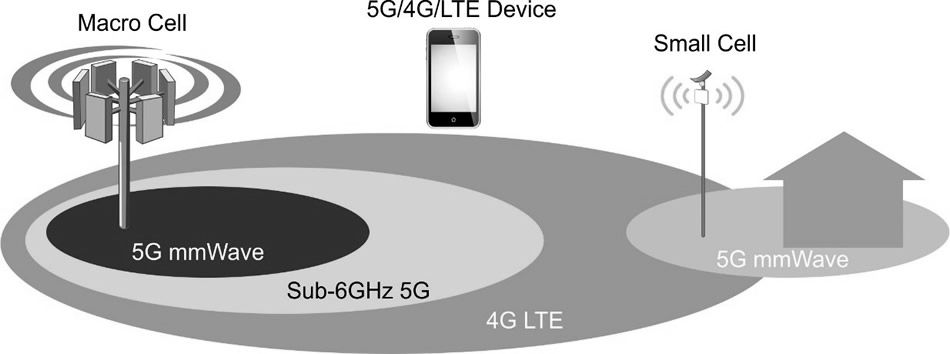
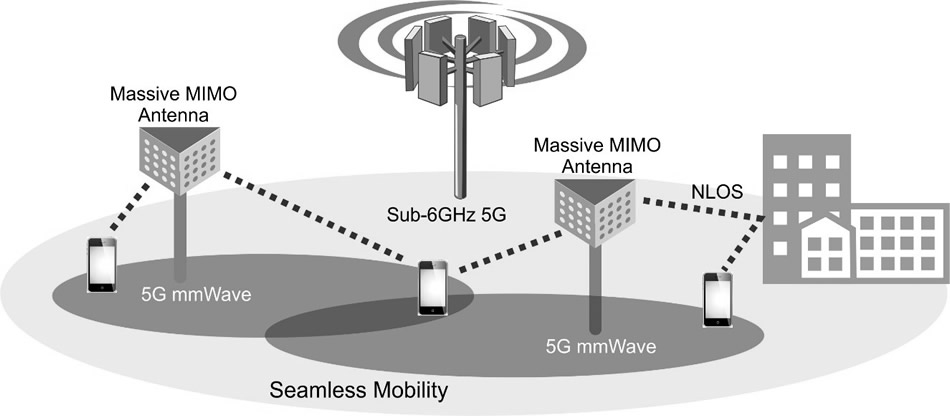
The high penetration losses and blocking mean that mmWave deployments will cover outdoor or indoor environments, but not provide outdoor to indoor connectivity. The mmWave cell sizes will, therefore, be smaller and higher in density. Also, it can be expected that mmWave will coexist in a tight integration with 5G deployments below 6 GHz as well as 4G LTE. Fast adaptation to changing channel conditions will enable switching within and across cells to maintain performance and coverage. In addition, there will almost certainly be a key role for Software-defined networking (SDN) and network functions virtualization (NFV) in how networks operate and provide seamless connectivity for users.
At the core of basic 5G mmWave technology is a new air interface based on time-division duplexing and robust orthogonal frequency division multiplexing (OFDM) methods similar to those as used in LTE and Wi-Fi networks. With peak throughput speeds of 10 Gbps or more and the ability to support a huge number of devices, 5G mmWave has performance targets that will deliver a transformation in how wireless communications are utilized.
5G mmWave uses Massive MIMO Antennas
Smaller cell sizes of 5G mmWave not only provides high throughput, but also allows for efficient use of spectrum as frequencies can be reused over relatively small distances. It is projected that outdoor cell sizes will be typically 100m to 200m and indoor high-density deployments might be as small as 10m. An important part of 5G mmWave performance is therefore dependent on line-of-sight (LOS) and non-line-of-sight (NLOS) propagation of signals and antenna design.
Great advancements made in RF silicon allow a large number RF chains to be supported in large antenna arrays. The computational and switching capacity available enables “massive multiple-input-multiple-output (massive MIMO)” antennas to create highly directional beams that focus transmitted energy in ways that can overcome path losses and NLOS conditions. A fundamental characteristic of mmWave, the short wavelengths, means that even massive MIMO antennas can be relatively compact and small effective antennas can be easily integrated into user devices. Whereas MIMO antennas for under 6 GHz wireless may support eight elements, at mmWave frequencies the number of massive MIMO elements might be 128, 256, or higher. These “phased arrays” perform the beam-forming, beam-steering, and beam-tracking techniques that enable a 5G mmWave network to deliver such high capacity and efficiency.
Likely 5G Millimeter Wave Deployment Scenarios
When outlining the requirements for 5G services, the International Telecommunication Union (ITU) identified three main categories for the 5G NR architecture; Enhanced Mobile Broadband (eMBB) for greater mobile capacity, Ultra-reliable and Low-latency Communications (uRLLC) for mission-critical services, and Massive Machine Type Communications (mMTC) for vast numbers of low-cost, low-energy devices (Internet of Things). These broad areas provide plenty of early deployment possibilities for 5G mmWave, such as the following:
- Fixed wireless Internet access. The Gigabit data rates of 5G mmWave could completely replace a number of Internet access technologies with hybrid fiber and wireless networks connecting subscriber homes. Although not truly a mobile system, it could provide competition to existing Wi-Fi systems that provide this type of fixed wireless access.
- Outdoor urban/suburban small cells. An expected deployment scenario for 5G mmWave would be to provide increased capacity in high-demand public spaces and venues. With cell sizes around 100m, small 5G mmWave access points can be placed on poles or buildings to provide the required coverage.
- Mission-critical control applications. Autonomous vehicles, vehicle-to-vehicle communications, drone communications, and other latency-sensitive, high-reliability applications provide other possible deployment scenarios for 5G mmWave with a projected network latency of less than a millisecond.
- Indoor hotspot cells. Shopping malls, offices, and other indoor areas require a high-density of 5G mmWave micro cells. These small cells will potentially support download speeds of up to 20 Gbps, providing seamless access to cloud data and the ability to support multiple applications, as well as various forms of entertainment and multimedia.
- Internet of Things. The general connectivity of objects, sensors, appliances and other devices for data collection, control, and analysis. Potentially could cover smart home applications, security, energy management, logistics and tracking, healthcare, and a multitude of other industrial operations.
The 5G mmWave Revolution
Implementation of new 5G mobile standards and the use of mmWave spectrum is expected to make major changes to the cellular industry. These mmWave bands being made available for mobile networks will provide increased performance, better coverage, and a closer integration across multiple wireless technologies from 4G LTE to Wi-Fi, to sub-6GHz 5G, as well as extending to the higher frequency 5G mmWave bands. Bringing all networks together will be an SDN architecture overlay that will provide seamless connectivity for an increasing number of users and networked devices.
5G mmWave is now being deployed in low-cost, small cell networks using massive MIMO antennas to deliver as much as 20 Gbps download rates to users, bringing the huge promise of 5G to fruit. When widely deployed, most expect a great increase in the number of applications and deployment scenarios that exploit the new mmWave 5G technology.
For Further Information
Please Contact Us